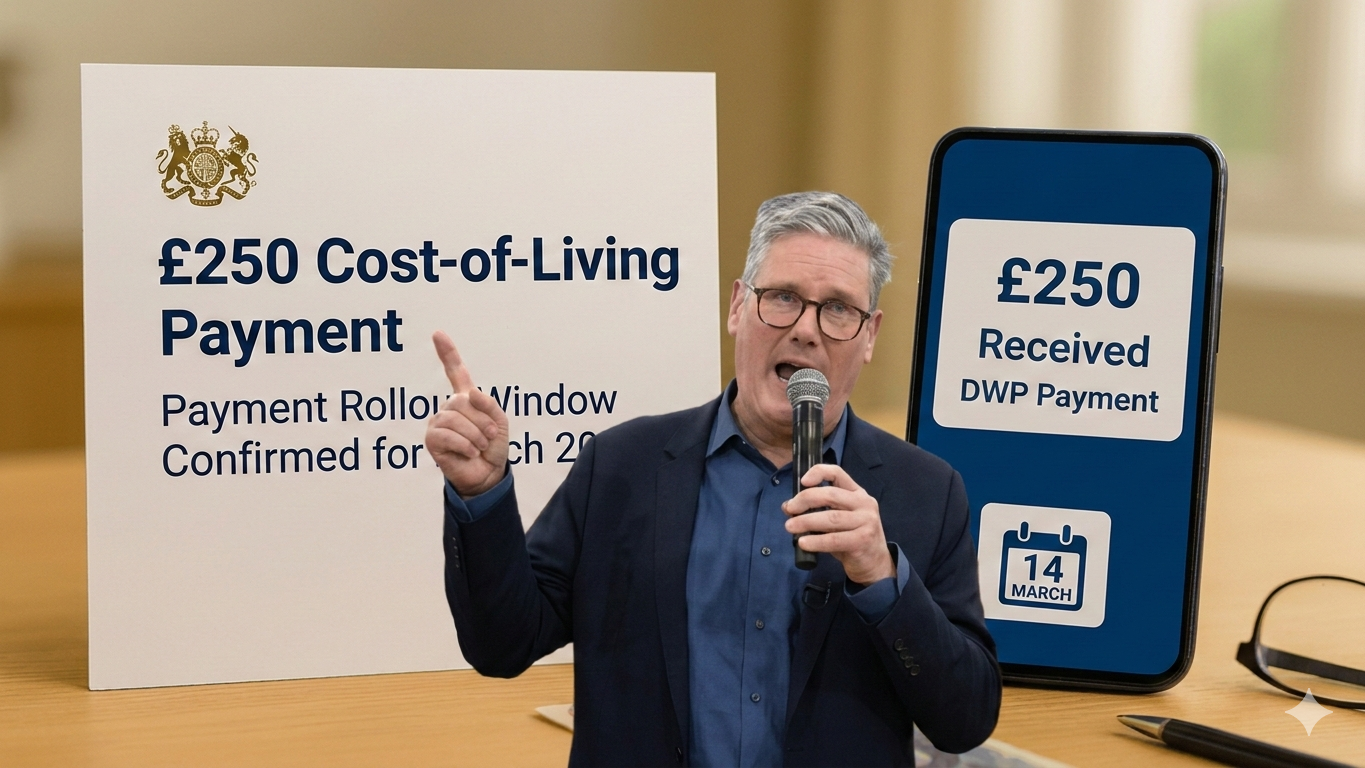
The British government has officially confirmed the dates for a new £250 Cost-of-Living payment, providing a much-needed financial cushion for millions of households across the UK. As energy bills remain unpredictable and food inflation continues to strain weekly budgets, this March 2026 rollout is designed to bridge the gap before the new financial year begins in April. Unlike previous blanket payments, this latest intervention is targeted toward specific vulnerable groups, ensuring that the support reaches those most affected by the current economic climate.
For many, the announcement comes as a relief after a winter characterized by high heating demands. The Department for Work and Pensions (DWP) and HM Revenue and Customs (HMRC) have coordinated to ensure that the payment window is tight and efficient, aiming to have the vast majority of funds in bank accounts before the Easter break. If you are a pensioner, a person with disabilities, or a low-income worker receiving certain benefits, understanding the eligibility criteria and the specific payment window is essential for your spring financial planning.
The Specific March Payment Window
The DWP has confirmed that the primary rollout window for the £250 payment will begin on Monday, 9th March 2026, and is expected to conclude by Friday, 27th March 2026. This three-week window is strategically placed to assist families as they transition out of the coldest months of the year.
Payments will be made automatically. This means there is no need to apply, and eligible individuals do not need to contact the DWP or their local council to trigger the funds. The money will be paid directly into the bank account where you normally receive your benefits or State Pension. Look for a reference on your bank statement that typically starts with “DWP COL” followed by your National Insurance number.
Who Qualifies for the £250 Support
Eligibility for this specific March 2026 payment is narrower than the universal energy grants seen in previous years. To qualify, you must have been entitled to a payment of a qualifying benefit during the “qualifying period,” which has been set as the window between 1st January 2026 and 15th February 2026.
The primary qualifying benefits include Universal Credit, Income-based Jobseeker’s Allowance (JSA), Income-related Employment and Support Allowance (ESA), Income Support, and Pension Credit. Additionally, those receiving Working Tax Credit or Child Tax Credit from HMRC will also be included in this rollout. If you are a pensioner receiving only the basic State Pension but have not yet applied for Pension Credit despite being eligible, the government is urging you to apply immediately, as successful backdated claims may still qualify you for this £250 boost.
Inclusion of Disability Benefit Recipients
In a welcome move, the 2026 rollout explicitly includes those receiving non-means-tested disability benefits. This includes Personal Independence Payment (PIP), Disability Living Allowance (DLA), and Attendance Allowance. The government recognizes that disabled individuals often face higher “hidden costs,” such as the need to run essential medical equipment or maintain a higher ambient temperature at home.
For those who receive both a means-tested benefit (like Universal Credit) and a disability benefit (like PIP), it is important to note that you will only receive one £250 payment. The system is designed to provide one payment per “eligible household unit” rather than per benefit type. This prevents “double-dipping” while ensuring that the maximum number of unique households receive support.
The Role of Local Council Support
While the DWP is handling the national £250 rollout, the government has also topped up the Household Support Fund (HSF) for March 2026. This fund is distributed by local councils and is intended for those who might narrowly miss the criteria for the national payment but are still in significant financial distress.
If you are a “squeezed” household—perhaps earning just above the Universal Credit threshold but struggling with rising rent or mortgage costs—you are encouraged to contact your local authority. Many councils are using their HSF allocation to provide supermarket vouchers, fuel top-ups, or small emergency grants. This local layer of support ensures that the March 2026 financial safety net has fewer holes than previous iterations.
Protecting Against Cost-of-Living Scams
Whenever the government announces a new payment rollout, scammers inevitably follow. The DWP has issued a “Red Alert” for March 2026 regarding fraudulent text messages and emails. These scams often claim that you “need to click a link to claim your £250” or ask you to verify your bank details to “activate” the payment.
It is vital to remember: The £250 payment is automatic. The DWP will never send you a text message with a link, and they will never ask for your bank details over the phone in relation to this payment. If you receive such a message, it is a scam. You should report it by forwarding the text to 7726 or emailing the National Cyber Security Centre. Do not interact with these messages, as they are designed to harvest your personal information during a time of high public interest.
The Economic Reasoning for the March Timing
Economists suggest that March is one of the most difficult months for UK households. While the days are getting longer, the “lag effect” of winter energy bills often hits bank accounts in late February and early March. Furthermore, many annual price increases for broadband, mobile contracts, and Council Tax are announced in March, leading to significant “bill anxiety.”
By injecting approximately £2 billion into the economy via these £250 payments, the government aims to stimulate local high-street spending while preventing a spike in personal debt. For many retirees, this payment will cover the gap left by the recent changes to the Winter Fuel Payment eligibility, providing a focused boost to those on the lowest incomes.
Impact on Universal Credit “Taper Rates”
A common question from workers on low incomes is whether this £250 payment will affect their Universal Credit “taper” or their eligibility for other benefits. The DWP has confirmed that the £250 Cost-of-Living payment is tax-free and will not count as income when calculating your benefit entitlement.
This means you do not need to report the payment to the DWP, and it will not result in a reduction of your regular monthly support. It is truly an “extra” payment. For those with savings close to the £6,000 or £16,000 capital limits, this one-off payment is also typically disregarded for a period of 12 months, ensuring that receiving help doesn’t accidentally disqualify you from your standard benefits.
The Situation in Scotland, Wales, and NI
The £250 rollout is a UK-wide initiative, but the administration varies slightly in the devolved nations. In Scotland, the payment will be coordinated alongside the Scottish Child Payment and Social Security Scotland’s own winter support packages. Residents in Northern Ireland will receive the payment through the Department for Communities.
While the £250 amount is consistent across all four nations, the “reference” on your bank statement might differ slightly depending on which agency is processing the payment. If you live in Wales or Scotland and haven’t received your payment by the end of the March window, you should check your specific national government website for any localized delays caused by regional bank holidays.
What to Do If Your Payment is Missing
If you believe you are eligible based on the benefits mentioned above but do not see the £250 in your account by 31st March 2026, the DWP has set up a dedicated “Missing Payment” portal on the GOV.UK website.
Before reporting a missing payment, the DWP asks that you check your bank account thoroughly for the “DWP COL” reference. It is also worth checking if you changed bank accounts during the qualifying period. If your old account is closed, the payment will “bounce” back to the DWP, and they will eventually contact you by post to ask for updated details. However, using the online portal from 1st April onwards is the fastest way to rectify a missing payment.
Future Outlook for Financial Support
As we look beyond the March 2026 rollout, the government has signaled a move away from one-off payments in favor of structural benefit reforms. The “Cost-of-Living” branding is expected to be phased out by the end of 2026 as the economy stabilizes.
This makes the March £250 payment a potentially final “crisis-style” intervention. The focus is shifting toward the “Back to Work” plan and raising the National Minimum Wage to ensure that long-term financial security comes from earnings rather than emergency grants. For those who are unable to work due to age or disability, the focus will remain on the Triple Lock and annual benefit uprating to keep pace with inflation.
Managing the £250 Boost Wisely
While £250 is a significant help, financial advisors suggest using the “Priority First” method when the funds arrive in March. If you have fallen behind on your “priority debts”—such as Council Tax, rent, or energy bills—these should be the first port of call. Paying off high-interest credit card debt or “Buy Now Pay Later” balances is also a highly effective use of the money to prevent further financial strain in the summer months.
For those who are currently up to date with their bills, March is an excellent time to use the payment to stock up on non-perishable essentials or to perform minor home maintenance that can improve energy efficiency before next winter, such as draft-proofing or servicing a boiler.
A Step Toward Financial Stability
The confirmation of the £250 rollout window for March 2026 is a vital piece of the puzzle for millions of people navigating the UK’s current economic landscape. It provides clarity in an uncertain time and ensures that the most vulnerable members of society are not left to face the end of the winter season alone.
As the 9th of March approaches, stay vigilant against scams, keep an eye on your bank statements, and remember that this support is a right, not a luxury, for those who qualify. The British government’s commitment to this targeted rollout shows a refined approach to social security, aiming to foster a sense of stability as the country moves into a new financial year.