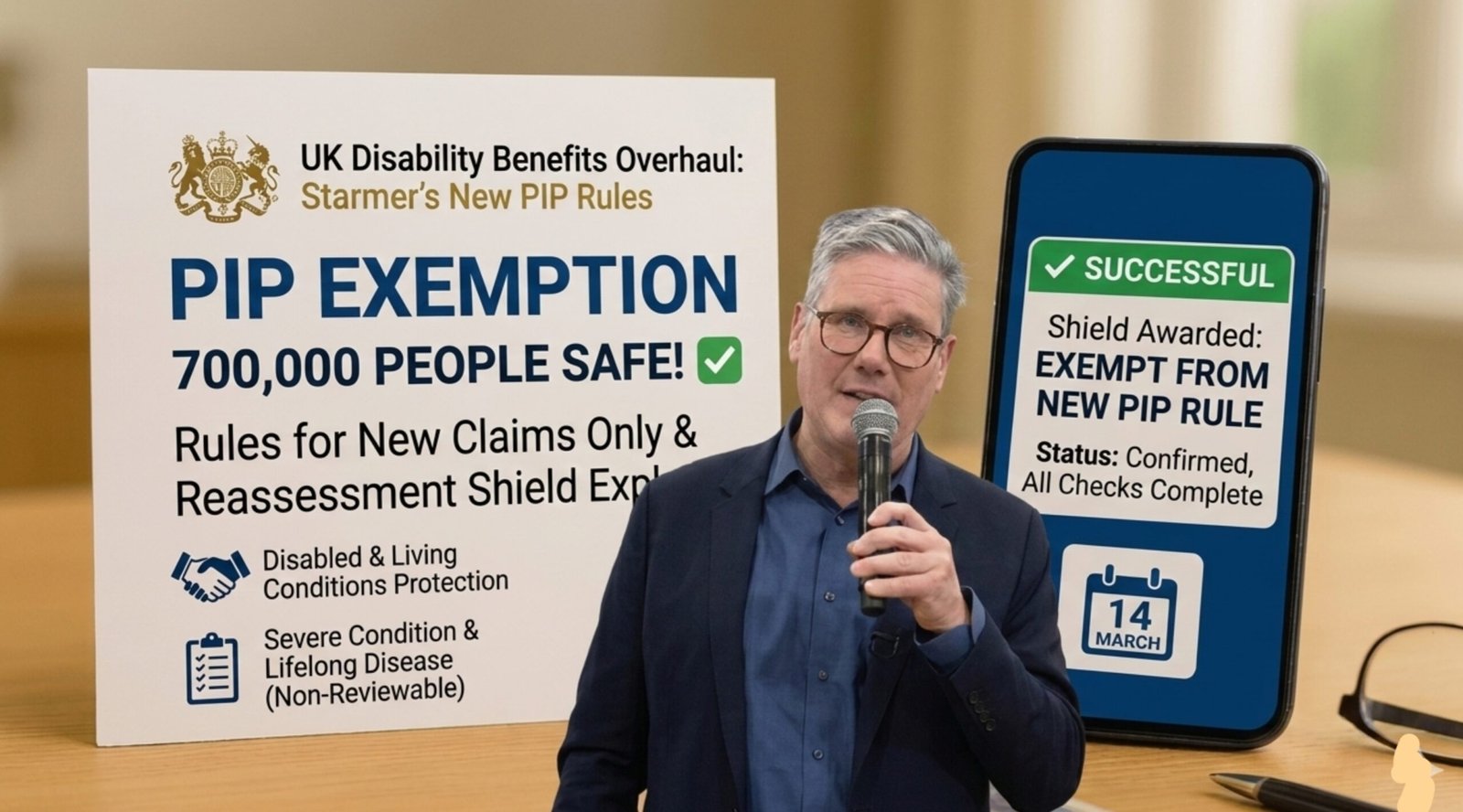
The British welfare system is undergoing its most significant transformation in a generation. For millions of people living with disabilities, the recent announcements from 10 Downing Street have brought a mix of apprehension and clarity. As Prime Minister Keir Starmer moves forward with a sweeping overhaul of the Department for Work and Pensions (DWP), the focus has landed squarely on Personal Independence Payment (PIP).
At the heart of this reform is a bold claim: nearly 700,000 people will be exempt from the most stringent of the new rules. For a government under pressure to cut the national benefits bill while protecting the most vulnerable, this “carve-out” is a critical component of their legislative strategy. This guide breaks down exactly what the new rules entail, who qualifies for the exemptions, and what it means for the future of disability support in the UK.
The Core of the PIP Eligibility Shift
The headline change revolves around how the DWP assesses daily living needs. Under the current system, claimants accumulate points across various categories—such as preparing food, washing, or dressing—to reach a total score. As long as you reach at least 8 points in total, you qualify for the standard rate.
However, the new rules, scheduled for implementation from November 2026, introduce a “four-point threshold”. New applicants will not only need 8 points in total, but they must also score at least 4 points in a single activity to qualify for the daily living component. This is a significantly higher bar, as activities that previously yielded 2 or 3 points will no longer be enough on their own to trigger a payment.
Who Are the 700,000 Exempt People?
The figure of 700,000 primarily refers to two specific groups who will bypass these stricter eligibility criteria and routine reassessments. The first and most significant group consists of individuals who have reached the State Pension age.
Currently, around 690,000 people aged 65 to 79 receive PIP. The DWP has officially confirmed that because pensioners are not routinely reviewed in the same way as working-age claimants, they will not be subject to the new four-point rule. For these seniors, the status quo remains, providing much-needed financial stability for those who have already navigated the transition into retirement.
Protection for the Terminally Ill
The second group included in these safeguards are those nearing the end of their lives. The government has maintained that the “special rules for end of life” will remain untouched. Individuals with a progressive disease and a life expectancy of 12 months or less will continue to access the enhanced rate of PIP through an expedited two-day fast-track process.
By exempting this group from the new point-scoring hurdles, the government aims to ensure that support reaches those in the most desperate circumstances without administrative delay. This “compassion-first” approach is intended to mitigate some of the fiercest criticisms leveled against the wider welfare cuts.
The Severe Conditions Criteria
Beyond the age-based exemptions, the 2026 overhaul introduces the “Severe Conditions Criteria” (SCC). This is a new classification for approximately 200,000 individuals with the most severe, lifelong, or degenerative conditions.
People who meet this criteria—including those with advanced neurological disorders or severe learning disabilities—will be exempt from routine reassessments. Under the old system, many people with permanent conditions were forced to go through stressful reviews every few years just to prove they were still disabled. From April 2026, those in the SCC group will see their awards made continuous, removing a major source of anxiety and administrative burden.
Impact on Existing Claimants
One of the most vital pieces of information for current PIP recipients is that the government has executed a significant U-turn. Initially, it was feared that every current claimant would be immediately reassessed under the tougher new rules.
However, following a backbench rebellion, Keir Starmer confirmed that the new eligibility criteria will only apply to new claims and those whose existing awards come up for a natural review after November 2026. This means if you are already in the system, your payments are protected for the remainder of your current award period.
Why the Overhaul Is Happening
The motivation behind these changes is purely economic. The UK’s welfare bill is forecast to reach nearly £378 billion by the end of the decade, with spending on health and disability benefits for working-age adults expected to hit £76 billion by 2030.
Prime Minister Starmer has described the current system as the “worst of all worlds,” arguing that it doesn’t do enough to help people back into work while simultaneously failing to provide adequate long-term security. The “rebalancing” of these benefits is designed to save an estimated £5 billion per year by tightening the gate for new applicants who have less severe mobility or daily living needs.
The Transition to the Timms Review
To ensure the new rules are “fair and evidence-based,” the government has commissioned a comprehensive review led by Welfare Minister Stephen Timms. This review is being “co-produced” with disability organizations and experts to shape the final assessment structure.
The findings of this review, expected in autumn 2026, will determine the final wording of the legislation before the November rollout. This collaborative approach is a direct response to the backlash from charities who warned that the initial proposals would push hundreds of thousands of disabled people into poverty.
What About Universal Credit?
The PIP overhaul is closely linked to changes in Universal Credit (UC). From April 2026, the DWP will freeze the “health element” of UC for most new claimants. Furthermore, the Work Capability Assessment (WCA) is set to be scrapped entirely by 2028, replaced by the unified PIP assessment.
This “single assessment” model is intended to simplify the system, but it also means that losing PIP could automatically lead to a reduction in your Universal Credit health-related payments. For those not in the exempt groups, the stakes of a PIP assessment have never been higher.
The Digital Shift and Future Reviews
As part of the 2026 modernization plan, the DWP is moving toward a “digital-first” approach for assessments. Video and telephone assessments will become the default option for most claimants, including those undergoing reviews.
Additionally, the DWP is integrating disability benefit databases with other services, such as free travel and Blue Badge records. This “joined-up data” means that if a person’s PIP award is cancelled or reduced under the new 2026 rules, their eligibility for a free bus pass or parking permit may be automatically reviewed or revoked.
Stability for Severe Condition Claimants
For the 700,000 people who fall into the exemption categories—particularly those with severe, lifelong conditions—the 2026 reforms actually offer a degree of newfound stability. By removing the threat of constant reassessment, the government is acknowledging that certain conditions simply do not improve.
For these individuals, the reform means:
-
Less psychological stress: No more “dreaded brown envelopes” requiring proof of a permanent disability every two years.
-
Financial Predictability: Awards will be more secure, allowing for better long-term budgeting.
-
Reduced Paperwork: A significantly lighter administrative load for claimants and their carers.
A System in Flux
While the exemptions provide a safety net for 700,000 people, the reality for new applicants after November 2026 will be starkly different. The “four-point rule” is a formidable barrier that will likely lead to many more people being denied support for moderate health conditions.
As we move toward the autumn 2026 conclusion of the Timms review, the focus will remain on how the government balances its fiscal targets with its duty of care. For now, if you are over State Pension age or living with a condition deemed “severe and lifelong,” the latest confirmation from the DWP suggests you can breathe a sigh of relief.
Next Steps for Your Claim
Would you like me to help you understand the specific criteria for the “Severe Conditions” group or find a list of disability organizations that can help you prepare for a PIP review in 2026?
Learn more about DWP PIP Assessment Changes
This video provides a concise overview of the UK government’s U-turn on planned benefit reforms, specifically discussing how changes will apply only to new claimants from November 2026 and why the Prime Minister made this decision.